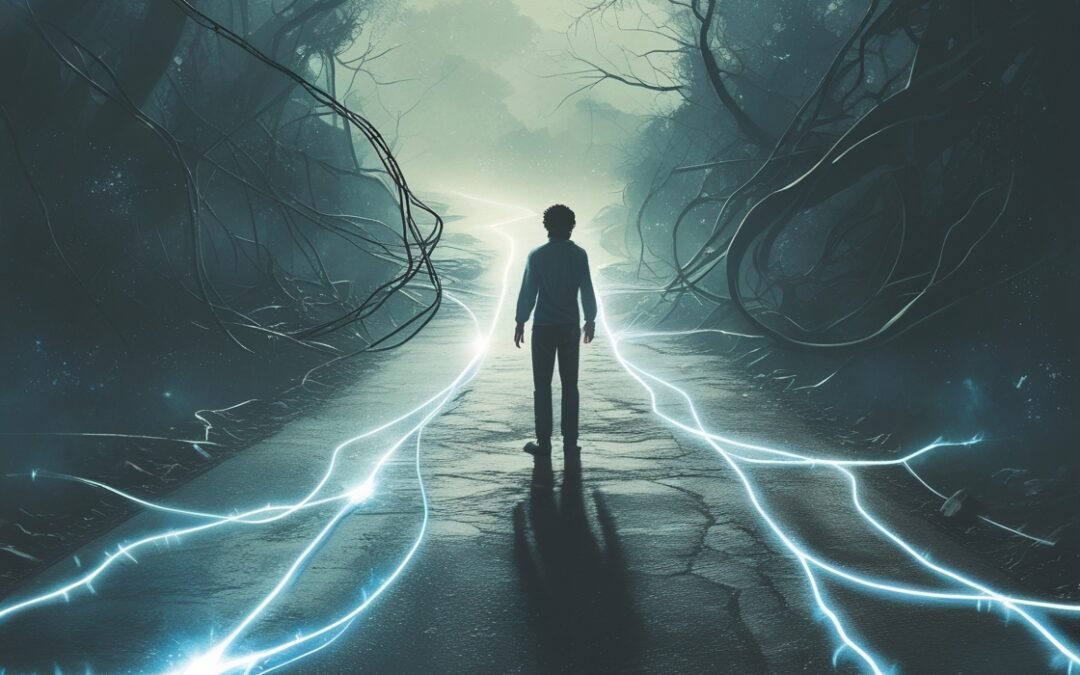
Have you ever picked something and found yourself thinking: “Did I just do that, or was it supposed to happen?” Maybe you decided to skip class, flirt-text someone, or try something new, and a part of you can’t help but ask yourself if it was even your decision. That’s the crux of one of the very oldest debates in the history of philosophy: free will versus determinism.
Determinism is the philosophical position that everything that occurs has a cause from what has previously existed. Every event, action, or thought has a chain of causes preceding it, ad infinitum. Picture a line of dominoes: when you push the first one, they all fall over in a chain reaction. In this case, all your decisions that you believe you are making are really part of the chain. Even some determinists contend that biology, environment, and society condition our choices so completely that freedom is a myth.
Free will, however, is the perception that we can make actual choices, choices which are not determined by what has happened in the past. Free will is what makes us feel responsible for what we do, to direct our lives, and to pursue our interests. Without free will, the notion of moral responsibility starts to collapse. If your actions were predetermined, would you be able to praise a person for kindness or criticize someone for cruelty?
Philosophers have sought to bridge the chasm. Compatibilists think determinism is compatible with free will. Whether the universe is governed by laws and events have causes dependent upon the past, we are free when we do something because we choose to, intend to, and find fit. Freedom does not have to be utterly untrammeled—it is doing something in accordance with who we are.
But this isn’t a philosophical argument, it’s one that affects life daily. Consider peer pressure, addiction, or social norms. Are you wearing something in some way because it’s genuinely you, or because in some way your environment has touched you ever so slightly? Are your hobbies inherently yours, or are they the result of raising, culture, or genes? Determinism asks us to look at the invisible chains that dictate our existence. Free will challenges us to be accountable for our choices and set a path despite everything.
Science brings another level. Neuroscience experiments reveal that our brains actually begin to initiate movements a fraction of a second before we actually make the decision to do so. Does this mean our brain decides, and we obey? Some interpret it as evidence against free will, whereas others assert only that it shows how complex decision-making is, our conscious mind could be the last to decide, gently steering outcomes.
Information regarding free will also influences how we live. Believing in ultimate determinism would likely be disempowering or depressing. But through going through the balancing act between freedom and destiny, we gain more awareness, reflection, and accountability. Even if we are not totally free, the fact that we can take responsibility for our patterns, biases, and influences is that we can make more mindful decisions.
For a teenager, this is especially insightful. You’re always making choices regarding identity, social life, school, and play. It’s natural to feel constricted by rules, norms, or social expectation, but awareness of free will causes you to reflect on your own choice. It is not a matter of rebelling against the surroundings, but of being aware of it and working through it thoughtfully.
At the end of the day, free will or not, the process of inquiry is the essence. In inquiry, “you ask Am I really free?”, you are embarked on one of human kind’s deepest most fundamental philosophical quests. You are seeking the extent of choice, responsibility, and self-knowledge. And in so asking, the ultimate freedom of all may be the freedom of mind, inquiry, and curiosity.